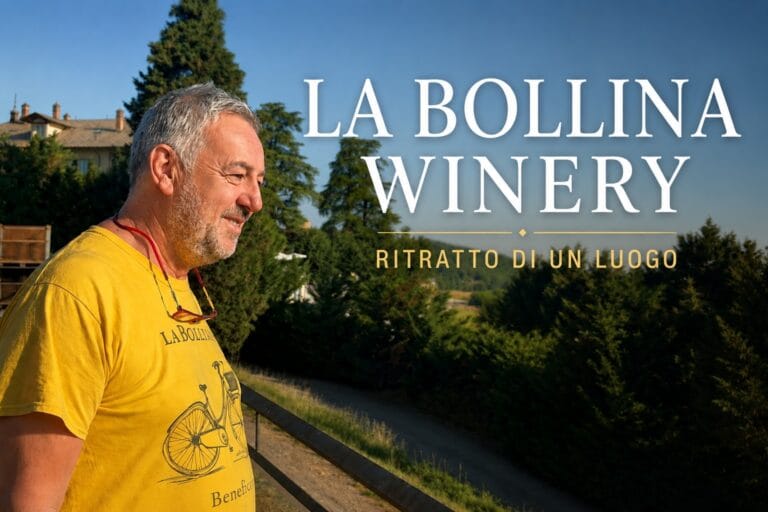
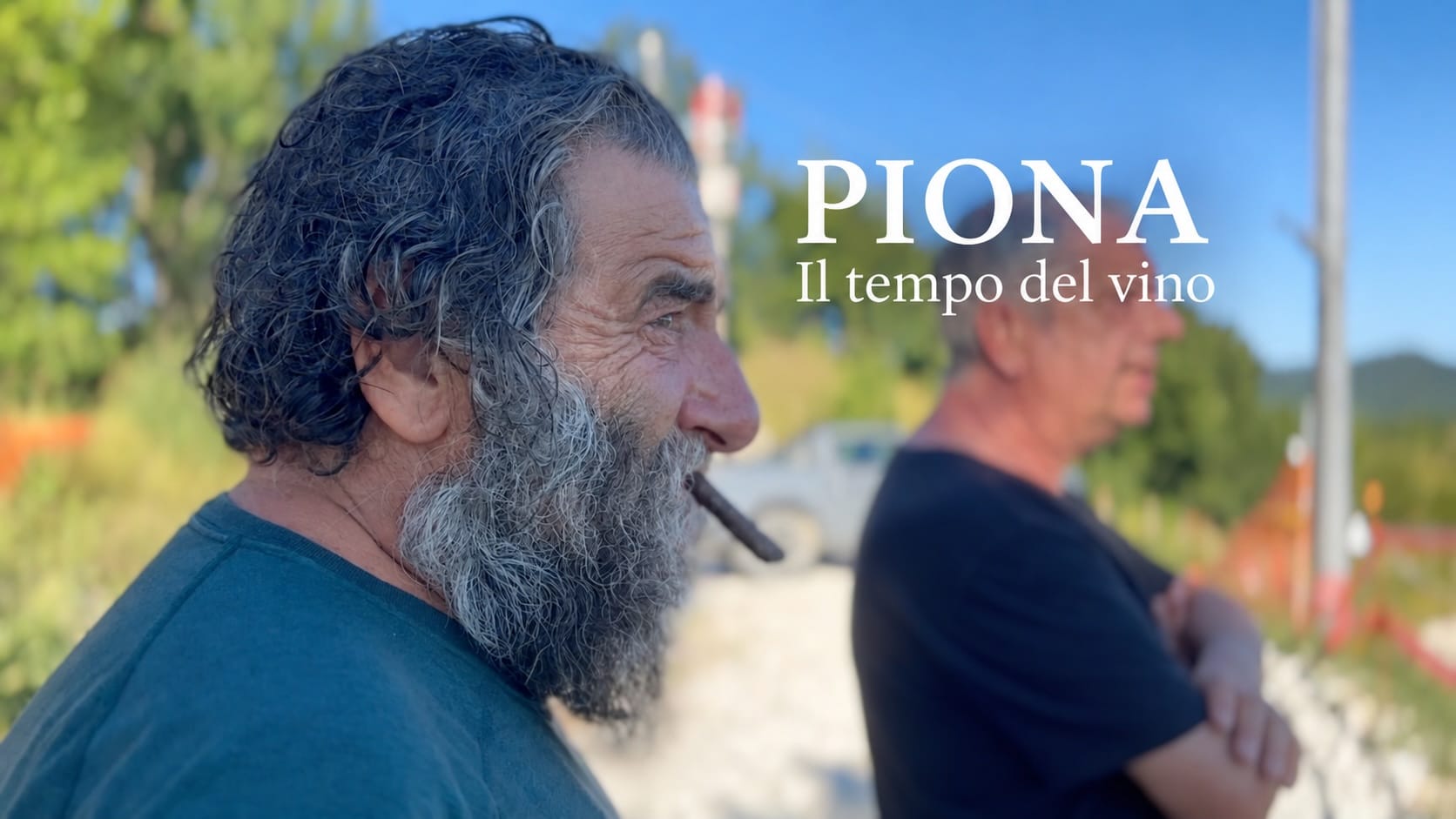
After completing La Bollina Winery: Portrait of a Place, I felt that something had been set in motion. The documentary had become the natural evolution of my podcast: from interviews entrusted entirely to voices, I had moved on to images, landscapes, gestures and silences. This new form of expression was already looking for another story.
In the place where I live, among hills covered with vineyards, wine is what connects people, landscape and memory. Its history has shaped the local culture for centuries and continues to influence its work, its relationships and even its perception of time.
I wanted to remain in the world of wine, because wine is also one of the great stories of the land where I live: the Gavi region. But I wasn’t simply looking for a winery. I wanted to meet a winemaker with a visceral connection to the land, someone for whom making wine was more than just a profession.
One evening, while having an aperitivo at a bar near my home overlooking the hills, a fascinating and unusual character sat down opposite me. He looked straight into my eyes and smiled without saying a word. A little later, he got up and went to talk to some other people.
A few evenings later, at the same bar, I told my friend Simona that I was looking for the protagonist of my second documentary. I explained that I wanted to listen to a winemaker who could speak about the land as something intimately connected to him. She didn’t hesitate for a moment: “Then you have to go and see him. He makes wine and has a beautiful place.”
And she pointed to the very man who had looked me in the eyes.
At that point, my choice had narrowed down to two winemakers: one who spoke to me without looking me in the eyes, and one who had looked me in the eyes without speaking.
Naturally, I chose the second one: Marco Gemme.
Marco did eventually speak — and, much to his own surprise, he spoke a great deal. Yet he was never tiring or boring. Quite the opposite: he turned out to be charismatic, insightful and extraordinarily photogenic. I had found the perfect protagonist.
When Paolo Amoretti and I arrived at Piona, just a few kilometres from Gavi, we discovered a world of its own. An open, 360-degree landscape, a large new winery still under construction, a beautiful house, an olive grove and vineyards that seemed to stretch endlessly into the distance: newly planted vines alongside old ones, custodians of another time.
Marco welcomed us generously, giving us his time and sharing knowledge acquired over nearly forty years of working as a farmer and winemaker. Above all, he showed us a particular way of understanding wine, summed up in a sentence that would become the heart of the documentary:
“Wine has its own time, just as we have ours.”
Marco does not see wine as something upon which one should impose one’s will. He listens to the grapes, observes what they can become and accompanies their transformation, allowing the wine to take shape according to its own nature and its own time. The winemaker remains present and guides the process, but does not try to dominate it or accelerate it through forced intervention.
For this reason, Piona: The Time of Wine also became a journey of discovery. Paolo Amoretti and I are both cooks and painters and, precisely because we work with flavours, materials and transformation, we thought we knew at least a little about wine. Faced with the knowledge Marco Gemme has accumulated over an entire lifetime, however, we discovered just how surprisingly ignorant we were.
Marco did not simply explain to us how wine is made. He shared with us part of his experience as a farmer and winemaker: knowledge built through observation, trial and error, memory, seasons and a daily relationship with the living material he works with. Paolo and I arrived at Piona to make a documentary and left having learned far more than we had ever imagined.
Perhaps this is also why the experience made me reflect on documentary filmmaking as a form of expression.
I have always felt the need to express myself and create, without ever wanting to bind myself permanently to a single language or medium. Painting, writing, music, cooking and photography have accompanied different periods of my life, often intertwining with one another.
Today, I am beginning to think that documentary filmmaking may be the form of expression that, more than any other, can contain everything I am. It encompasses images and photography, portraiture, music, attention to detail and the poetry of everyday life. But there is also something less visible: my anthropological perspective, which began to develop during the years I studied anthropology at the University of Siena.
Anthropology taught me to pay attention to other people’s perspectives, to the different ways in which we perceive and interpret the world, shaped by culture and individual experience. Making a documentary means entering, at least for a while, into another person’s way of seeing. It means going beyond simply gathering information and trying instead to understand how that person gives meaning to their own life and work.
And perhaps it was precisely by entering Marco’s way of seeing that I recognised something in his relationship with wine that goes beyond his profession.
Each of us expresses ourselves differently and, when that expression becomes authentic, to me it becomes art.
I have never believed that artists are a species separate from the rest of humanity, as though only certain people were gifted with particular sensitivity and talents while everyone else were excluded. I believe, rather, that we are all potential artists.
Some remain trapped within the structures of rationality and allow little room for their creativity. Others, like me, feel an almost irresistible need to express themselves, regardless of the language or medium they choose. But art can manifest itself wherever a person follows their own path and manages to express themselves from the heart, spontaneously and authentically.
It does not necessarily require a canvas, a musical instrument or a camera. Some people create through colour, some through food, and some by cultivating the land and accompanying living matter through its transformation.
For this reason, in my eyes, Marco Gemme is an artist of wine.
His language is made of grapes, seasons, fermentation, tasting and waiting. Like every authentic artist, he possesses a profound knowledge of his material, but he does not use that knowledge to suffocate it beneath his own will. He observes it, listens to it and guides it, leaving it the space it needs to express what it contains.
Perhaps this is where the winemaker meets the painter and the cook: all of them transform matter, but they must also learn not to dominate it completely. They must know technique well enough to move beyond it, recognising when to intervene and when to let things happen.